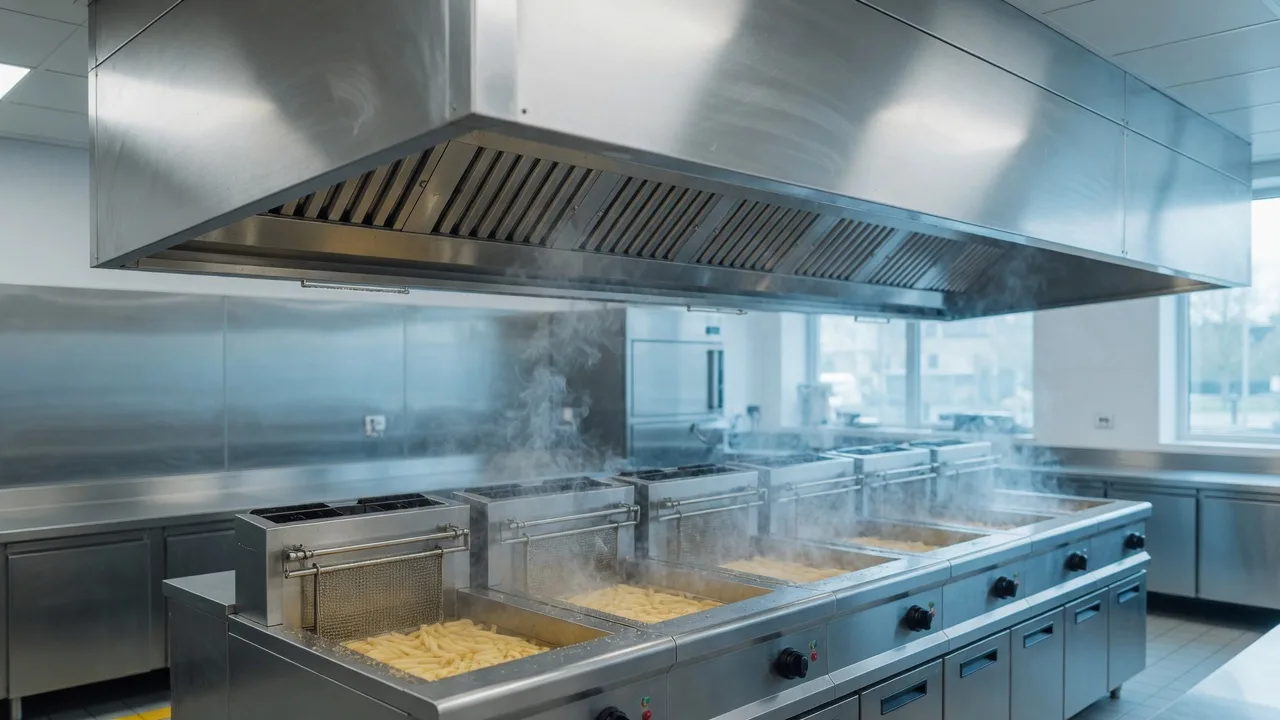
In a high-volume fast food or quick service restaurant (QSR) kitchen, the extract system is the single most important fire safety and hygiene asset you own. Clean Ducts delivers BESA TR19 Grease-compliant kitchen extract cleaning that keeps that system fire-safe, hygienic and insurable, working with national franchises, regional chains and independent takeaways to run their maintenance schedules with zero disruption to trading.
The critical role of TR19 Grease compliance in fast food
Fast food operations run long hours and rely heavily on frying and grilling, so they are typically classified as high-use kitchens. Grease accumulates rapidly inside the extract ductwork, turning a critical ventilation system into a severe fire risk and a hygiene problem.
That accumulation is not a slow background process. Every service sends fat, oil and grease into the canopy, through the filters and along the ductwork, where it condenses and hardens on internal surfaces you never see. Those deposits are fuel, sitting directly in the path of the heat and flame your equipment produces all day. The same build-up chokes extraction efficiency, so the kitchen runs hotter, staff work under greater heat stress, and smoke and odours start to drift into the dining area. Left alone, it becomes a hygiene problem in its own right.
Our service goes beyond a basic clean. It is a structured, certified compliance process that protects your staff, customers, property and bottom line. We manage schedules across busy metropolitan areas such as London and high-street sites across the Home Counties, including Slough, Milton Keynes and Southampton.
Our core services for fast food and QSRs
Our services are built for the intensive demands and strict compliance requirements of the food service sector:
- Kitchen extract systems cover commercial kitchen duct cleaning to BESA TR19 Grease standards, removing accumulated fat, oil and grease (FOG) throughout the system: canopy, filters, ductwork and fan.
- Canopy and fan cleaning: deep cleaning of accessible canopy surfaces, baffles and extract fans, restoring extraction efficiency, reducing heat stress on staff and controlling odours and smoke in the dining area.
- Ductwork maintenance includes the installation of access panels where required, so the entire duct path can be reached for a full TR19 deep clean. Full access protects your insurance position as well as the clean itself: an unreachable section is an uncleaned section, and an uncleaned section undermines your certificate.
- Ventilation and HVAC: ventilation surveys and inspections, plus repair and maintenance of mechanical air ventilation, so the replacement air system stays balanced and negative pressure is avoided.
- Fire safety and compliance covers post-clean compliance certification and photographic reporting, giving auditable evidence for insurers, Environmental Health Officers (EHOs) and fire risk assessments.
Professional credentials and reliability
Your business needs a fast, reliable and compliant service. Our credentials back that up:
- BESA TR19 Grease specification: technicians trained to the current BESA TR19 Grease standard, the recognised UK benchmark for the internal cleanliness of kitchen extract systems. We work to the required post-clean residual grease deposit thickness, typically under 200 microns.
- BESCA Vent Hygiene Associate. Clean Ducts is a BESCA Vent Hygiene Associate member.
- Certified documentation: photographic certificates of cleanliness and detailed reports, accepted by UK insurers and fire authorities. Without this evidence, a fire insurance claim can be invalidated.
- Minimal disruption. We clean out of hours, typically overnight or early morning, so your kitchen keeps its trading hours and revenue intact.
- National capability, local focus. We run planned preventative maintenance (PPM) schedules for large, multi-site operators nationwide, with teams focused on high-density areas such as Greater London, the Thames Valley and the wider South East.
What a TR19 Grease clean involves at your site
A TR19 Grease clean is a structured job with a defined output, not a wipe-down. Knowing the sequence helps you judge any quote you are given, including ours.
The starting point is a survey. We confirm how your system is laid out, where the grease is sitting and how heavy the deposits are, then agree the scope and the schedule with you. Where duct runs are long or awkward to inspect, a CCTV camera survey of the ductwork records the internal condition of the system, so the state of your ductwork is documented rather than assumed.
The clean itself covers the whole system, not just the parts you can see from the kitchen: canopy, filters, ductwork and fan. Where sections of the duct path cannot be reached, we install access panels before cleaning, because a section that cannot be accessed cannot be cleaned, and a section that cannot be cleaned cannot be certified.
Once the work is complete, residual grease deposits are checked against the TR19 Grease benchmark, typically under 200 microns, and the results are recorded photographically. You receive a certificate of cleanliness and a detailed report to hold on file for your insurer, your fire risk assessment and any EHO inspection. The whole job runs out of hours, so the first your day team sees of it is a clean system and the paperwork.
Legal obligations for fast food kitchen extraction
Cleaning and maintaining a fast food kitchen’s extract system is not just best practice; it sits under real legal duties and, for most operators, conditions of insurance cover:
- The Regulatory Reform (Fire Safety) Order 2005 (RRFSO) places a duty on the Responsible Person, such as the owner or manager, to take reasonable steps to reduce fire risk. Grease build-up in extract ductwork is a major fire risk, which makes regular, certified cleaning necessary under this law.
- Health and Safety at Work etc. Act 1974 and the Workplace (Health, Safety and Welfare) Regulations 1992 require employers to provide a safe working environment with adequate and suitable ventilation. Dirty, inefficient systems lead to poor air quality, heat stress and hygiene issues.
- Insurance requirements: the most immediate pressure is contractual rather than statutory. Most UK commercial building and contents policies make documented extract cleaning a condition of cover, with BESA TR19 Grease the evidence insurers recognise. If you cannot produce a valid certificate following a fire, you are at serious risk of the claim being rejected. Policies differ, so check yours, but the pattern across the market is consistent.
Recommended cleaning frequencies
Fast food businesses usually fall into the high-use category because of their long operating hours. BESA TR19 Grease sets cleaning frequency by daily usage:
| Usage level | Operating hours per day | Recommended cleaning frequency |
|---|---|---|
| High use (typical fast food / QSR) | 12-16+ hours | Every 3 months (quarterly) |
| Moderate use | 6-12 hours | Every 6 months (bi-annually) |
| Low use | 2-6 hours | Every 12 months (annually) |
Scheduling for franchises and multi-site operators
If you run one takeaway, compliance is a diary entry. If you run dozens of sites, it is a logistics problem: different trading hours, different insurers and a certificate that must be current at every single unit. That is what our planned preventative maintenance schedules are built for.
We manage PPM schedules for national franchises, regional chains and independent takeaways alike. Cleans are booked to the TR19 frequency your usage demands, carried out to the same standard at every site and documented in the same format, so your estate holds one consistent body of compliance evidence rather than a patchwork of paperwork from different contractors. Our teams are concentrated where fast food density is highest: Greater London, the Thames Valley and the wider South East, with regular coverage of high-street sites across the Home Counties, including Slough, Milton Keynes and Southampton, and national capability beyond that.
Fast food kitchen extract cleaning FAQs
Is TR19 Grease cleaning a legal requirement?
BESA TR19 Grease is an industry standard rather than a statutory law, but following it is the only verifiable way to demonstrate due diligence under the Fire Safety Order (RRFSO), and it is a requirement of nearly all commercial insurance policies. For a high-risk environment like a fast food kitchen, quarterly (three-monthly) deep cleaning is often the minimum requirement.
How often should a fast food kitchen extract be cleaned?
For most fast food and QSR sites, quarterly. TR19 Grease sets cleaning frequency by hours of daily use, and a kitchen frying and grilling for 12-16 or more hours a day sits firmly in the high-use category, which calls for a deep clean every three months. Shorter trading days can stretch that to six or twelve months, but few fast food operations genuinely qualify as moderate or low use, and your insurer will expect your schedule to match your actual hours, not the category you would prefer to sit in.
Why does grease build up so quickly in fast food kitchens?
Because of what and how you cook. Long trading days built around frying and grilling send a constant stream of fat, oil and grease into the extract system, where it condenses on the internal surfaces of the canopy, filters, ductwork and fan. That is why TR19 Grease places typical fast food and QSR kitchens in the high-use category, and why the recommended cleaning interval is three months rather than a year.
Will the clean disrupt trading?
No. We clean out of hours, typically overnight or early morning, and hand the kitchen back before service begins. Your trading hours and your revenue stay intact; we work around your operation, not the other way round.
What documentation do we receive?
A photographic certificate of cleanliness and a detailed report on the work carried out. Both are accepted by UK insurers and fire authorities, and together they form the auditable evidence you need for your fire insurance, your fire risk assessment and any visit from an Environmental Health Officer. Keep them on file; they are the proof that your due diligence is real.
What happens if we cannot produce a certificate after a fire?
You are at serious risk of the claim being rejected. Most UK commercial building and contents policies make documented extract cleaning a condition of cover, with BESA TR19 Grease the recognised evidence, and without a valid certificate that proof does not exist. Individual policies differ, which is exactly why the certificate matters: it satisfies the strictest of them. It is the single largest financial exposure covered on this page, and the most straightforward one to remove.
Some of our ductwork is boxed in and hard to reach. Can it still be certified?
Yes. Where the duct path cannot be reached, we install access panels as part of the job, so the entire run can be cleaned and photographed rather than left as an unknown. A gap in your compliance evidence is exactly what an insurer will look for after a fire, so closing those gaps matters as much as the cleaning itself.
Do you cover multiple sites?
Yes. We run planned preventative maintenance schedules for multi-site operators nationwide, from national franchise estates to regional chains, with the same standard, frequency and reporting format at every site.
To confirm the grease levels in your extract system, or to set up a compliant cleaning schedule for your fast food or QSR site, request a survey and we will take it from there.